1999 vs Redeveloped Curriculum: What Actually Changes
Every staffroom in the country is having some version of the same conversation right now: “So what’s actually different?”
After 27 years with the 1999 curriculum, a change this size can feel like the ground is shifting under your feet. But when you put the two side by side, you’ll see that the core of what you do in the classroom hasn’t been thrown out. It’s been reorganised, updated, and in some cases genuinely improved.
Here’s a straight comparison, written for the teacher who needs to understand the differences without reading 400 pages of NCCA documents.
The structure
1999 curriculum: 11 individual subjects, grouped into 7 curriculum areas. Each subject has strands, strand units, and content objectives. You plan by selecting specific content objectives for your class level.
Redeveloped curriculum: 5 broad curriculum areas, with subjects sitting within them. Each subject has strands (sometimes called elements) and Learning Outcomes. You plan by selecting Learning Outcomes, which describe what children should be able to do.
The biggest structural shift is integration. The 1999 curriculum kept subjects quite separate: History was History, Geography was Geography, Science was Science. The redeveloped curriculum groups some of these together. SESE becomes Social and Environmental Education (SEE). Science joins with Technology and Engineering to form STEM Education. PE and SPHE merge into a broader Wellbeing area.
This doesn’t mean you stop teaching History or Geography as distinct subjects. In 3rd to 6th class especially, the curriculum becomes more “differentiated” into discrete subjects. But in Junior Infants to 2nd class, the expectation is a more integrated learning experience.
Content objectives vs Learning Outcomes
This is the change that affects your planning most directly.
Content objectives (1999) are quite specific. They tell you what to teach. For example, a 3rd/4th class Maths content objective might say: “Identify and record simple fractions: halves, quarters, eighths, thirds, fifths, sixths, tenths, twelfths.”
Learning Outcomes (redeveloped) are broader. They describe what the child should be able to demonstrate. The equivalent Learning Outcome might say something like: “Recognise, name, and represent commonly-used fractions in context.”
The outcome gives you more flexibility in how you get there. The trade-off is less specificity, which can feel like less guidance if you’re used to the 1999 approach. Some teachers find this liberating. Others find it vague. Both feelings are valid.
For your planning, this means your fortnightly plan might reference fewer, broader outcomes rather than a longer list of specific objectives. Your learning activities and assessment approaches carry more weight in showing how you’re addressing those outcomes.
The subjects
Here’s a quick map of what went where:
| 1999 Curriculum | Redeveloped Curriculum |
|---|---|
| English | Language (English) |
| Gaeilge | Language (Gaeilge) |
| (not included) | Language (Modern Foreign Languages), new |
| Mathematics | Mathematics |
| Science | STEM Education |
| (Technology was cross-curricular) | STEM Education |
| History | Social and Environmental Education |
| Geography | Social and Environmental Education |
| SPHE | Wellbeing |
| PE | Wellbeing |
| Visual Arts | Arts Education |
| Music | Arts Education |
| Drama | Arts Education |
A few things to notice:
- Modern Foreign Languages is entirely new at primary level. Schools will introduce this from Stage 3 (3rd/4th class).
- Science gains a much stronger technology and engineering component.
- SPHE and PE are now part of a broader Wellbeing area that also includes Social, Personal and Health Education (SPHE) and concepts around consent, identity, and mental health.
- Religious Education / Ethical and Multi-belief & Values Education has reduced time (roughly 2 hours per week, down from the current allocation), reflecting the changing social landscape.
What stays the same
More than you’d think:
- The child-centred approach: the 1999 curriculum was praised internationally for putting the child at the centre. The redeveloped curriculum builds on this, not replaces it.
- The school year: 182 days, no change. Total instructional hours are the same, 23.5 hours per week plus recreation. Infant classes stay at 18.5 hours.
- The planning layers: you still need a school plan, long-term plans, fortnightly (short-term) plans, and Cuntais Míosúla. The formats may evolve, but the layers remain.
- Teacher autonomy: you still choose how to teach. The curriculum sets out what children should learn, not how you deliver it.
- Assessment: still teacher-led, still varied (observation, questioning, tasks, portfolios). No new standardised tests coming as part of this change.
The phased rollout
This is crucial to understand. You are not expected to switch everything in September 2026.
The Language and Mathematics specs are already in play. If your school has adopted the Primary Language Curriculum (PLC 2019) and the Primary Mathematics Curriculum (PMC 2023), you’re already using redeveloped content.
From September 2026, the remaining areas phase in: Wellbeing, Arts Education, Social and Environmental Education, and STEM Education. Schools will adopt these over the coming years, with full implementation expected by 2032/33.
That’s a seven-year window. You have time.
What this means in practice
Right now, most teachers are in a hybrid position:
- Language: Planning from PLC 2019 (Learning Outcomes for English and Gaeilge)
- Maths: Planning from PMC 2023 (Learning Outcomes)
- Everything else: Still planning from the 1999 curriculum (content objectives)
Over the next few years, you’ll gradually swap in the new specs as they’re introduced and as your school adopts them. Your planning will reference a mix of content objectives and Learning Outcomes, and that’s perfectly normal during a transition.
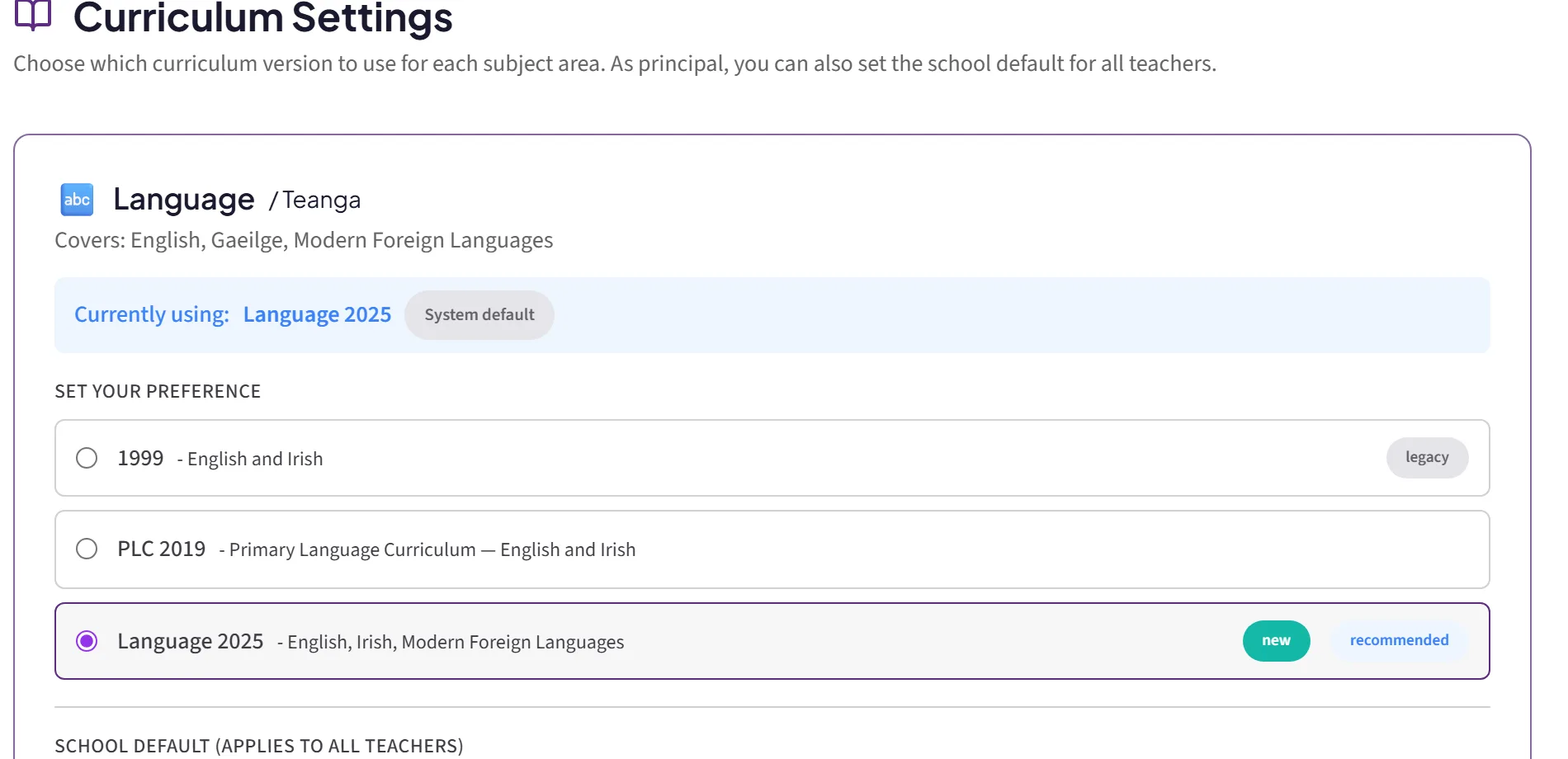
The key is having clarity on which curriculum version you’re using for each subject, and being able to access the right content when you sit down to plan. That clarity is exactly what Pleanáil’s Curriculum Settings holds: one version choice per curriculum area, so every plan you build pulls 1999 content objectives for the subjects still on 1999 and Learning Outcomes for the rest, each cited to the correct document.
You can also put the two side by side for your own class right now: the free Learning Outcomes explorer shows the real redeveloped outcomes for any class and subject, no sign-up needed, and our subject-by-subject guide for this year settles which document each subject plans from.
The bottom line
The redeveloped curriculum is a renovation. The house is the same, the rooms have been rearranged, and some new ones added. You still know how to teach. You still know your children. You just need to get familiar with where things are now.
Give yourself grace. The transition is a multi-year process.
Pleanáil has the full 1999 curriculum and every published redeveloped specification built in, so your plans reference the right document for each subject automatically, all in one place. Try the whole workflow free for 30 days: three full plans, a real Cúntas Míosúil, and long-term plans for your year. No card needed.
Plan against the real 2026 curriculum
Pleanáil loads the redeveloped and 1999 curriculum for you. Tick the Learning Outcomes, tap a suggestion or two, and your fortnightly plans, Cúntas Míosúil and long-term plans assemble themselves. A plan that used to take an evening takes about fifteen minutes.
Start your free 30-day trialFor solo teachers and whole schools.