The first month of the redeveloped curriculum: what September's planning actually looked like
September 2026 was the first month of the redeveloped curriculum’s enactment, and the commentary beforehand ran in two directions: either everything was about to change, or nothing would really happen for years. Now that the first month is done, we can see what teachers actually did.
What follows comes from anonymised, aggregated planning activity across the classrooms planning on Pleanáil in September. No individual teacher or school is identifiable in any of it, and we would not publish it any other way. It is a window into real planning, in the first month that the new specifications counted.
The planning folder is a hybrid, and that is the design working
Of all the subject pages planned in September, roughly four in ten were planned from the 1999 curriculum. It was the single most-used curriculum document of the month, in the first month of the new era.
That is worth sitting with, because plenty of teachers quietly worry that still planning from 1999 means their school is behind. The opposite is true: with language and maths already on their own newer curricula and one enactment area per school beginning this year, most of the week’s subjects are supposed to be planned from 1999 in 2026/27. The data shows the whole country doing exactly that.
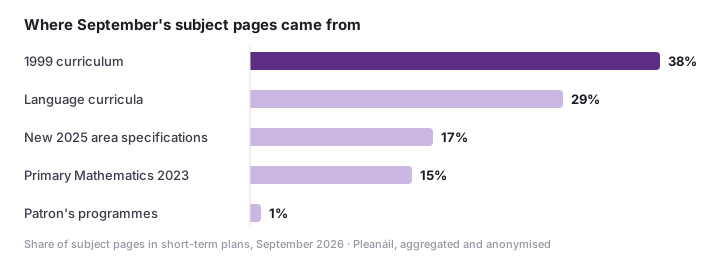
The rest of the month’s planning split roughly like this: about three in ten pages from the language curricula, about one in seven from the 2023 maths curriculum, and about one in six from the new 2025 area specifications, with patron’s programmes making up the remainder. Every one of the new specifications (Arts, Wellbeing, Social and Environmental Education, Science Technology and Engineering) appeared in real plans in its first month. If you are still settling which document each subject plans from, our subject-by-subject guide lays it out.
Wellbeing is the front-runner enactment area
Among teachers who have made an explicit call on a curriculum area, a clear pattern: about seven in ten who decided on Wellbeing chose the 2025 specification, while SESE and Arts Education split close to half and half between the new specification and 1999.
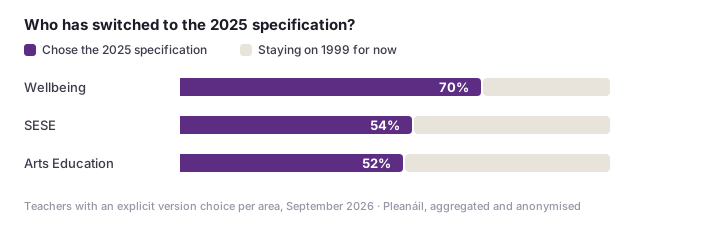
That tracks the rollout’s own design. Wellbeing must be among the first three areas a school takes on, and for many schools it is the natural starting point: the ground covered by SPHE and PE is familiar, and the new specification gives it a shape staff can gather around on the school-led planning day. If your school went a different direction, that is the system working too; the choice is deliberately school-led.
Want to see what the new Learning Outcomes look like before your area’s turn comes? The Learning Outcomes explorer shows them for any class and subject, free, no sign-up.
Almost a third of plans covered more than one class level
Here is the September statistic that deserves more attention than it gets: nearly one short-term plan in three was a multigrade plan, covering two or more class levels in one document, and a further group were SET plans spanning several levels of a caseload.
Multigrade teachers carry the heaviest planning load in the system, and during a curriculum transition they carry it across two curricula at once. If that is your classroom, one plan, not four was written for you, and our free SET group planning template covers the support-teaching version of the same problem.
The fortnight still rules, and the month is gaining
Roughly nine in ten teachers planned by the fortnight in September. But about one in ten planned by the month, and a smaller group, mostly NQTs on Droichead, planned week by week.
Monthly planning is now officially recognised, and September’s data suggests teachers are quietly taking the invitation, especially for the first month of a new year when routines and baseline assessment stretch beyond a fortnight’s horizon. One question we were asked during the month is worth answering here: yes, a Cúntas Míosúil can be generated from weekly, fortnightly or monthly plans alike. The rhythm is yours to choose; the record at the end of the month works the same way.
When planning really happens
Spare a thought for the folder’s unseen hours. In September, about a third of all plans were written at the weekend, nearly one in five on a Sunday, and around four in ten were written after six in the evening.
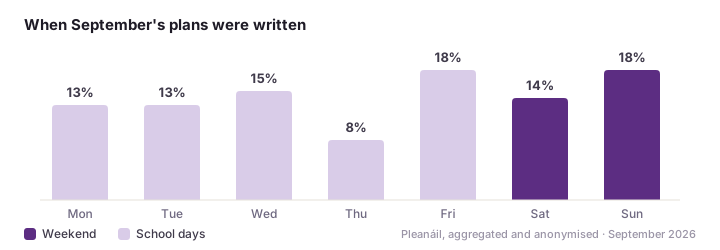
Nobody timetables that; it is simply where planning lands when the school day is full. It is also why we keep the fifteen-minute plan as the bar to clear: if the Sunday-evening plan is real, the least a planning tool can do is make it short. The 15-minute method is our best attempt at giving that hour back.
The first Cúntais wrote themselves
As the month turned, the first wave of Cúntais Míosúla landed, and the teachers who got there fastest had done nothing extra at all: their September plans already held the work covered and the curriculum references, so the Cúntas generated from them and needed only a read-through and a reflection.
That is the quiet lesson of the first month. The teachers finding the transition lightest are planning normally, from the right document per subject, and letting the records assemble themselves downstream.
What this means for your October
Three practical takeaways from the first month:
- Planning from 1999 for most subjects is the norm, documented across the country’s classrooms. Reference the right document per subject and move on.
- If Wellbeing is your school’s area, you are in the largest company; if not, your school’s choice is the system working as designed.
- The Cúntas is downstream of the plan. Whatever rhythm you plan in, put real content in the plans and October’s record largely writes itself.
Pleanáil holds the 1999 curriculum and every published redeveloped specification side by side, so September’s hybrid folder lives in one place: fortnightly, weekly or monthly plans, long-term plans, and a Cúntas Míosúil generated from what you taught. Start your free 30-day trial.
Plan against the real 2026 curriculum
Pleanáil loads the redeveloped and 1999 curriculum for you. Tick the Learning Outcomes, tap a suggestion or two, and your fortnightly plans, Cúntas Míosúil and long-term plans assemble themselves. A plan that used to take an evening takes about fifteen minutes.
Start your free 30-day trialFor solo teachers and whole schools.