New Primary Curriculum 2026: What Changes This September
September 2026 is the first September of the redeveloped primary curriculum. It is also, if the staffroom conversation is anything to go by, the most misunderstood September in years. Some teachers have heard they will be planning every subject from new documents. Others have heard nothing changes for ages yet. Neither is true, and what is actually changing is more manageable than either version.
This is the whole picture in one place: what the Primary Curriculum 2026 rollout actually asks of your school this year, what stays exactly as it is, and what it means for the folder you will sit down to write in late August.
The timeline at a glance
| When | What happens |
|---|---|
| September 2026 | Every school begins enacting at least one area from its new specification. Only one area receives Oide/NCSE support this year; a second is supported from September 2027 (Circular 0052/2026) |
| 2026/27 | Four support closure days (three Oide-supported, one school-led) for planning the enactment (Circular 0052/2026) |
| By end of 2027/28 | Revised subject time allocations fully in place (Circular 0052/2026) |
| From 2028/29 | Schools may take a consolidation year to pause and embed areas already in progress |
| The years after | Remaining curriculum areas phased in, roughly two years each, through the early 2030s |
The design principle behind the phasing is simple: no teacher is asked to relearn every subject at once.
What the redeveloped curriculum is
The redeveloped curriculum is organised, under the Primary Curriculum Framework, into five curriculum areas:
- Language (English, Irish and Modern Foreign Languages)
- STEM (Science, Technology, Engineering and Mathematics)
- Wellbeing (PE and SPHE)
- Arts Education (Visual Arts, Music and Drama)
- Social and Environmental Education (History and Geography)
Language and Mathematics are already in use in every school (the Primary Language Curriculum and the 2023 Primary Mathematics Curriculum), so those parts of the Language and STEM areas are settled. The new area specifications a school actually begins to enact from 2026 are Wellbeing, Social and Environmental Education, Science, Technology and Engineering (the science strand of STEM, alongside the maths that is already in place), Arts Education, and Modern Foreign Languages (from 3rd Class).
Underneath the areas sit seven key competencies that run through everything: the knowledge, skills and dispositions the curriculum wants children to develop across their eight years. And instead of the 1999 curriculum’s content objectives, the new specifications are written in Learning Outcomes, the same style you already know from the Primary Language Curriculum and the 2023 maths curriculum.
What changes in September 2026
One thing, chosen by your school: the first enactment area.
From September, each school begins planning and teaching at least one of the five areas from its new specification. The choice is school-led. Your school weighs its own context and picks its starting point, and Wellbeing must be among the first three areas a school takes on. To make space for that decision, 2026/27 includes four support closure days, three supported by Oide and one school-led, with the school-led day specifically for staff to plan the enactment together.
So the single most useful question you can ask before the summer break is: which area has our school chosen? That answer tells you which part of your planning moves to the new Learning Outcomes in September. Everything else about your planning year flows from it.
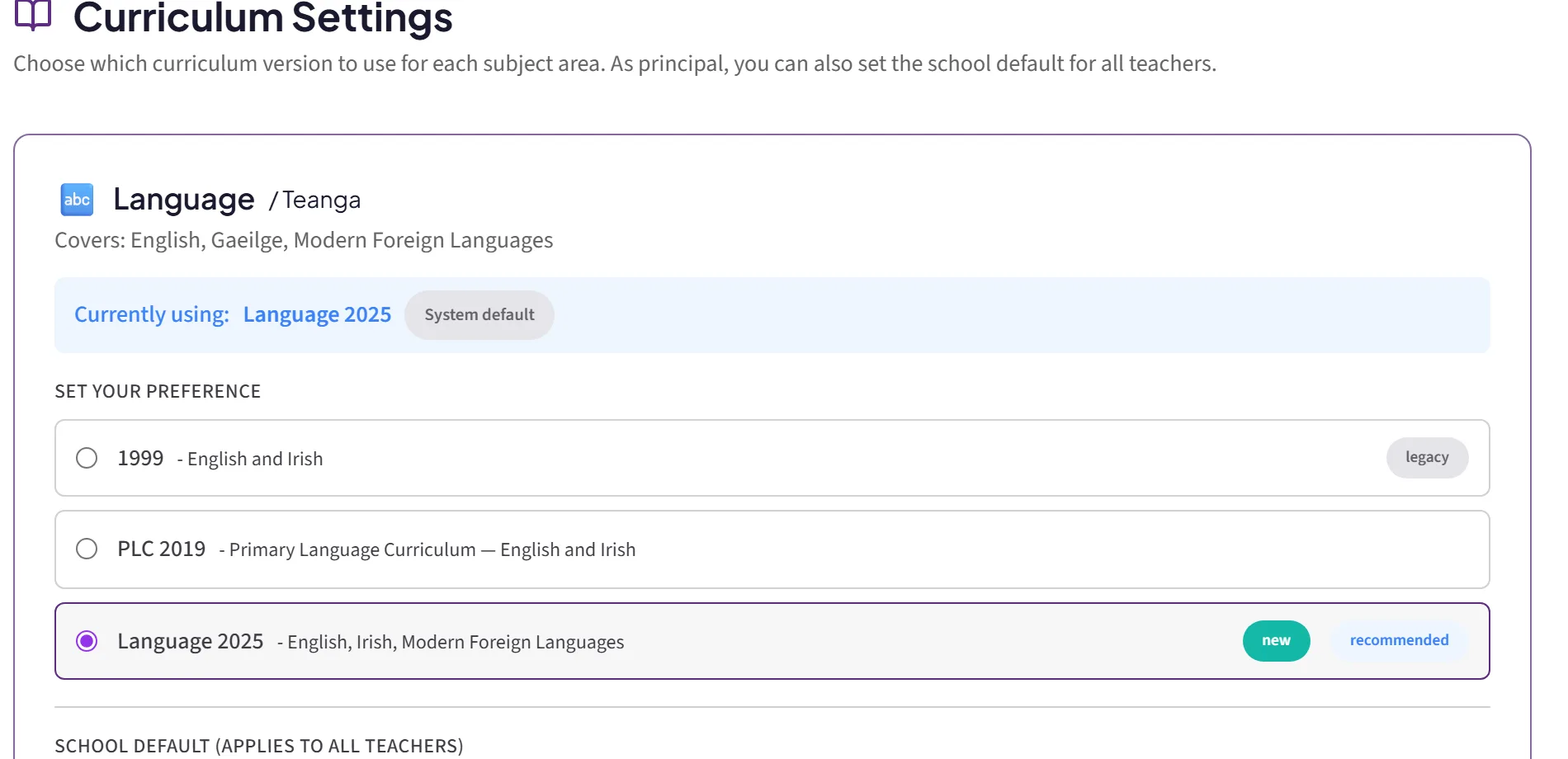
In Pleanáil, that whole decision is one setting. Curriculum Settings holds a version choice per curriculum area, so when your school names its enactment area you switch that one area to the 2026 specification, and every plan you make after that pulls the right Learning Outcomes for it. Every other subject stays on the curriculum it uses today.
What doesn’t change
More than most teachers expect:
- English and Gaeilge stay on the Primary Language Curriculum (2019). You are already planning with Learning Outcomes there, and that continues.
- Mathematics stays on the Primary Mathematics Curriculum (2023).
- Every other subject outside your school’s enactment area stays on the 1999 Primary School Curriculum, with its strands, strand units and content objectives. The 1999 curriculum is still doing real work in 2026/27, and planning from it is not a sign your school is behind.
- The length of the week: total instruction time is unchanged at 23.5 hours (18.5 for infant classes). The revised time allocations redistribute time across areas, and schools have until the end of 2027/28 to complete that change.
If you want the subject-by-subject version of this, we wrote a full guide to which curriculum to plan from for every subject. And if you would like to see the new Learning Outcomes themselves, pick your class and subject in our free Learning Outcomes explorer - the real outcomes from the redeveloped specifications, no sign-up needed.
What it means for your planning
The updated Guidance on Preparation for Learning, Teaching and Assessment (2026) sets the tone for planning in the new curriculum: concise, practical, flexible, and owned by the teacher. Long, copied-forward documents are exactly what the guidance moves away from.
You can see what a concise, transition-ready plan looks like in this completed fortnightly plan template: real subjects, the right Learning Outcomes for each, and nothing padded.
Practically, a 2026/27 planning folder holds three kinds of curriculum content side by side:
- Learning Outcomes for English, Gaeilge, Maths, and your school’s enactment area
- Content objectives under strands and strand units for the 1999 subjects
- Whole-school decisions flowing down into both, since your long-term plan is expected to reflect your school’s curriculum plans
That side-by-side folder is exactly what Pleanáil holds for you. When you add a subject to a plan, you tick the Learning Outcomes or content objectives for your class from the correct document, and the plan sets them out in the right structure with the right citation:
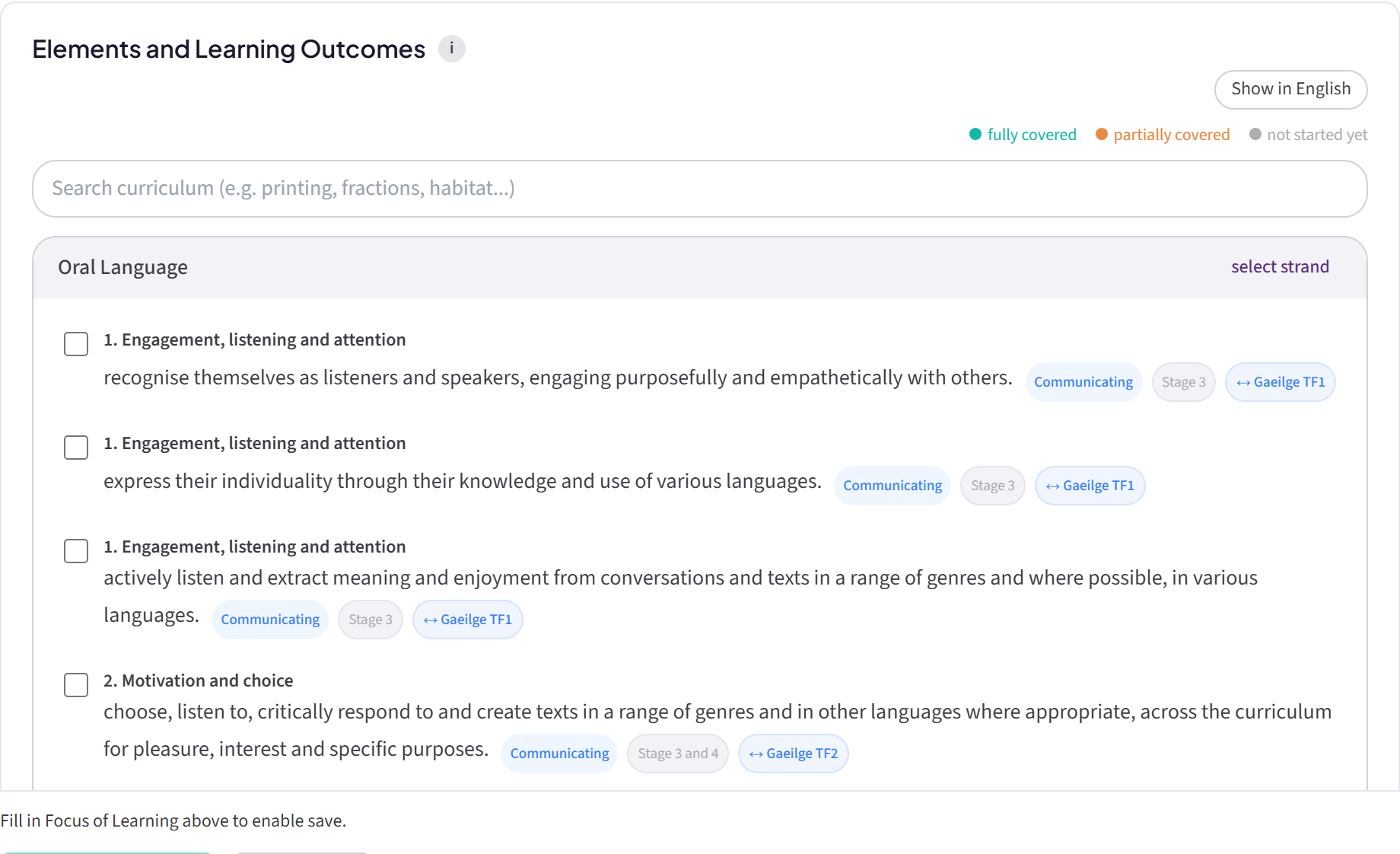
Your plans never need to explain the transition. They need to reference the right document for each subject, and stay concise. If you are building your year from scratch, our long-term planning method for September and the September planning checklist walk through it step by step.
Common questions
Does the whole curriculum change in September 2026? No. One curriculum area (at minimum) begins enactment per school. Language and maths continue on their current curricula, and the rest stays on the 1999 curriculum for now.
Who decides which area our school starts with? Your school does. The rollout is deliberately school-led, and the school-led closure day (one of four in 2026/27) exists so the staff can plan the choice together.
Do I have to rewrite all my plans? You rewrite planning for the enactment area against its new specification. The rest of your planning carries forward against the documents it already uses, though the 2026 preparation guidance is a good prompt to make everything more concise.
Is the 1999 curriculum gone? Not for years. Most subjects outside language, maths and your enactment area are still planned from it in 2026/27, and the phased rollout continues into the early 2030s.
Both curricula in one place for 2026
Pleanáil was built for exactly this transition. The Learning Outcomes from the redeveloped specifications are loaded alongside the Primary Language Curriculum, the 2023 maths curriculum, and the full 1999 curriculum. When you add a subject to a plan, the correct curriculum version for that subject and class level is simply there, and your printed plans cite it correctly.
Which means the tool carries the transition, and your planning time goes where it belongs: deciding what your class will learn.
Get your 2026/27 planning off to the right start: three full plans, a real Cúntas Míosúil and long-term plans for your year, free for 30 days, no card needed. Create your first plan free.
Plan against the real 2026 curriculum
Pleanáil loads the redeveloped and 1999 curriculum for you. Tick the Learning Outcomes, tap a suggestion or two, and your fortnightly plans, Cúntas Míosúil and long-term plans assemble themselves. A plan that used to take an evening takes about fifteen minutes.
Start your free 30-day trialFor solo teachers and whole schools.